Kualoa
Kualoa Management Framework
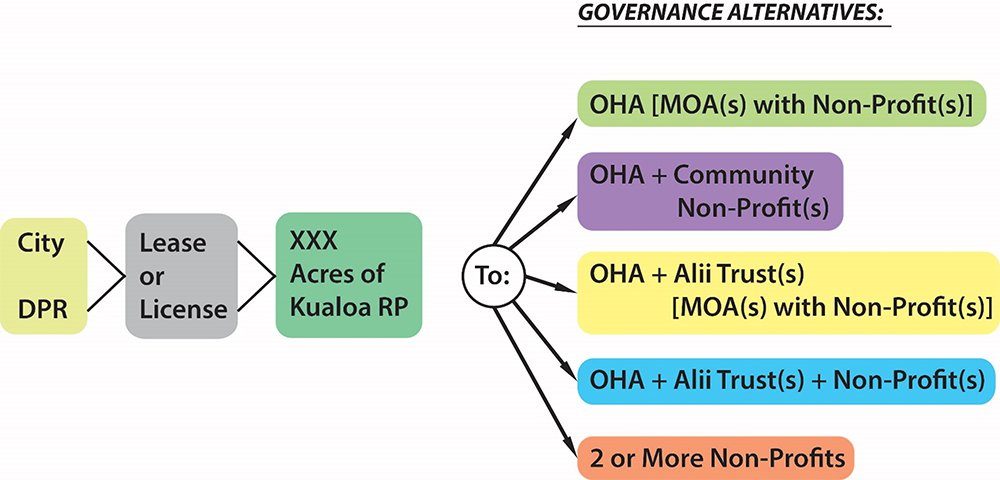
In order for any of the proposed projects or programs to be implemented by other organizations on City land, there will need to be agreements between these implementing entities and the City. Such an agreement could be in form of a lease or license for a portion of the park, plus a Memorandum of Agreement (MOA). Several potential alternatives were explored and suggested for partnership agreements among different entities. Some community members are particularly interested in OHA becoming involved as the agency holding a lease, with MOAs between OHA and whichever organizations are to provide programs. For example, OHA could obtain a lease for a portion of the park and sign an MOA with a non-profit to provide educational programs. Or OHA could jointly hold a lease together with a non-profit. OHA has expressed willingness to explore these approaches including to become a leaseholder that would provide for various levels of collaboration for program implementation. The Mayor of Honolulu has also expressed support for a unique management framework to enable program implementation by community groups and is interested in seeing this project serve as a model for future community-based programs on City land. The diagram below shows some of the conceptual alternatives of agreements that may be considered.
The National Historic Preservation Act (NHPA) in which Congress has declared “the cultural foundations of the Nation should be preserved as a living part of our community” recognizes an number of formal approaches to support public private collaborations toward that end and may provide a model for this proposed Management Framework; they include:
- Memorandum of Understanding: To document a framework for cooperation between the public entity and other parties for carrying out their separate activities in a coordinated and mutually beneficial manner
- Participating Agreement: To enter into agreements to cooperatively perform mutually beneficial projects with public and private agencies, organizations, institutions, or persons; mutually beneficial projects may include but are not limited to: development of programs and activities, the protection, restoration, and enhancement of fish and wildlife habitat, and other resources, cooperative manpower, publication of materials for education related to programs.
- Challenge Cost-Share Agreement: To cooperate with other parties to develop, plan, and implement projects that are mutually beneficial; cooperators may be public and private agencies, organizations, institutions, and/or individuals.